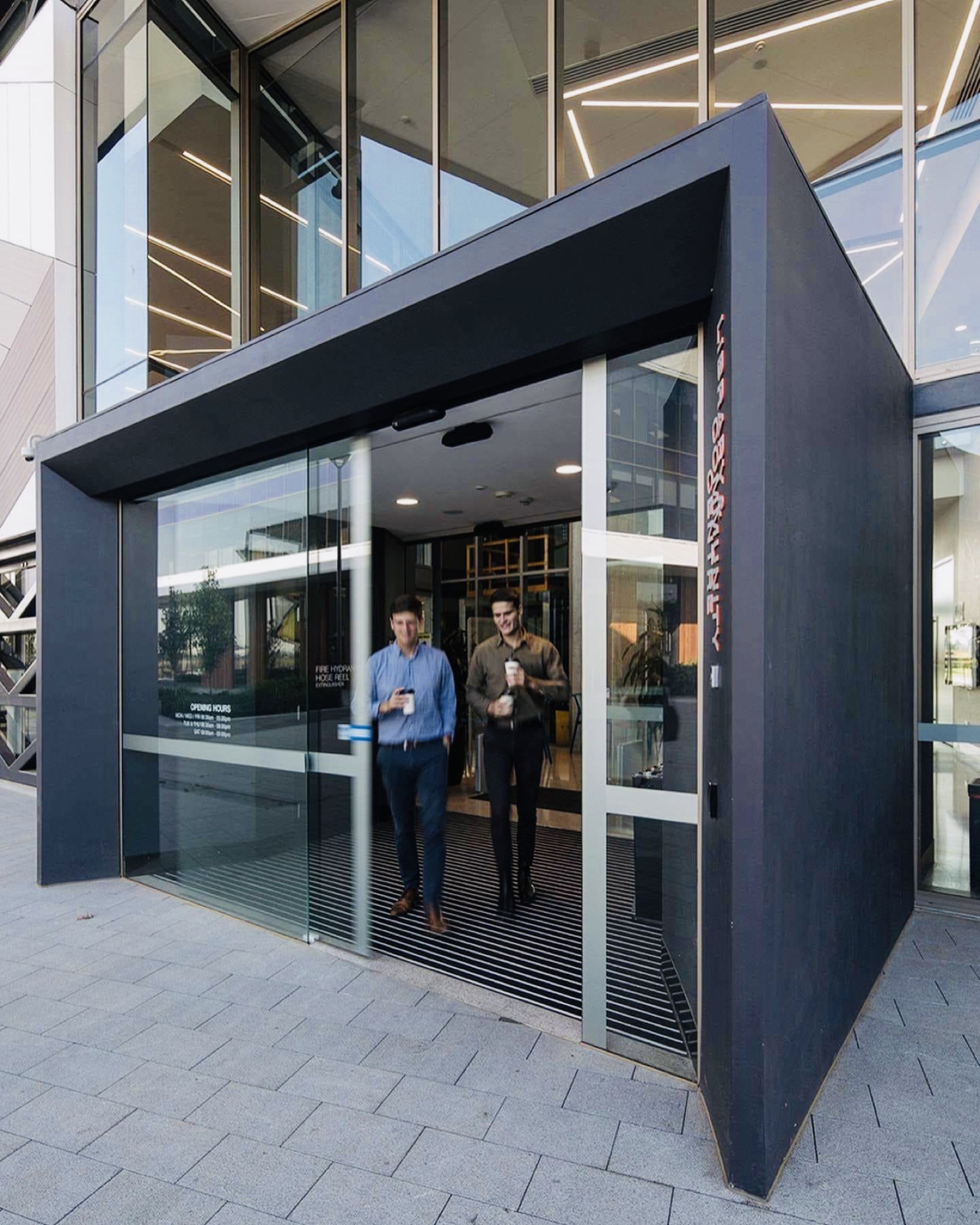
Automatic sliding door durability is the question that decides whether an entrance is an asset or an annual repair bill. Any operator will open a door on the day it is commissioned. What separates them is what the mechanism looks like after two hundred thousand people have walked through it. The Coetz™ MC-125 automatic sliding door system is tested for 1,000,000 maintenance-free cycles and carries a 2-year manufacturer warranty, and this guide explains what those two figures actually mean, how they translate into years on your own doorway, and where automatic sliding door durability is genuinely won or lost.

What automatic sliding door durability actually measures
Durability in this context is not a marketing adjective. It is a cycle count. One cycle is a single complete operation — the door detects an approach, opens fully, holds, and closes again. Automatic sliding door durability is the number of those cycles the mechanism completes before wear makes it unreliable.
This matters because entrance doors are among the hardest-working moving parts in any building. A structural element is loaded once and then simply stands there. An automatic entrance accelerates a mass of glass and aluminium from rest, decelerates it, stops it precisely, and repeats that several hundred times a day, every day, for years. Automatic sliding door durability is really a question about fatigue: how many times can the rollers, belt, motor and controller repeat that sequence before something gives.
It also explains why comparing operators on price alone is misleading. Two units can look identical in a showroom and differ by an order of magnitude in cycle life. The specification that separates them is not the one on the front of the brochure.
The one million cycle test, translated into years
The MC-125 is tested for 1,000,000 maintenance-free cycles. That figure is abstract until you divide it by your own traffic, so here is the arithmetic for a few realistic entrances. These are simple calculations from the cycle rating, not separate performance claims.
- A quiet office reception at roughly 150 cycles a day reaches one million cycles in about 18 years.
- A busy suburban pharmacy or clinic at roughly 300 cycles a day reaches it in about 9 years.
- A retail store in a shopping centre at roughly 500 cycles a day reaches it in about 5 and a half years.
- A high-traffic mall entrance at roughly 1,000 cycles a day reaches it in about 2 years and 9 months.
The word that carries the weight in that specification is maintenance-free. It is not the point at which the door stops working. It is the period through which the mechanism is designed to run without intervention. Understood properly, automatic sliding door durability of one million cycles tells a facilities manager how long the entrance should stay off the maintenance schedule, not how long before it is scrapped.

What a 2-year manufacturer warranty tells you
Every MC-125 automatic sliding door is backed by a 2-year manufacturer warranty. A warranty is worth reading as a statement of confidence: a manufacturer sets the term at the point where it expects failures to be rare enough to absorb. Read alongside the cycle rating, the two figures are consistent — on the traffic levels above, two years sits comfortably inside the tested envelope for most entrances.
There is a practical dimension too. A warranty is only as useful as the people honouring it. Coetz™ supplies the MC-125 and installation and servicing are arranged through our parent company, MC Automations Entrance Systems, operating from the same premises in Johannesburg. One accountable team handles the project from site measure through to aftercare, and we stock the operators, sensors, drive belts and control boards we fit, so a repair does not wait on an imported part. That supply position is a large part of real-world automatic sliding door durability: a door that is down for three weeks waiting for a component is, from the building’s point of view, a failed door.
Where automatic sliding door durability is won or lost
Cycle life is decided by a handful of components. When an entrance fails early, it is almost always one of these rather than the operator as a whole.
The drive motor and gearbox
The MC-125 uses a brushless motor with an integrated gearbox. Brushless designs remove the brushes that wear as a consumable in older motor types, which is directly relevant to automatic sliding door durability — it eliminates a scheduled wear item from the drivetrain.
Rollers and track
The main rollers carry the full weight of the leaf across every cycle. The MC-125 carries leaves up to 150 kg on a single-leaf installation, or 2 × 120 kg on a double. Specifying a leaf at the top of that range on a very high-traffic entrance loads the rollers harder than the same door on a quiet one, which is why traffic volume belongs in the specification conversation and not just opening width.
The drive belt
The belt is the component most likely to be replaced first over a long service life. It is a wear part, it is stocked locally, and replacing it is routine. Treating the belt as consumable rather than as a failure is the correct way to think about long-term automatic sliding door durability.
The controller
The MC-125 is microprocessor-controlled with a wide-voltage design for stable operation on variable mains — a meaningful specification in South African conditions, where supply quality varies and equipment is repeatedly power-cycled. Deceleration control matters here too: a door that decelerates into its end stops rather than arriving at full speed subjects every mechanical component to lower peak loads on every cycle.

Access control integration without compromising durability
The MC-125 integrates readily with access control systems — card and fob readers, keypads, intercoms, biometric readers and electric locks. This is worth calling out in a discussion of automatic sliding door durability because integration is a common source of premature wear when it is done badly.
The failure pattern is consistent: an access control system is added later by a separate contractor, wired so that the door is commanded to open and close in a way the operator was not set up for, and the entrance begins short-cycling — opening and closing repeatedly on a single approach. Every unnecessary cycle is deducted from the door’s rated life. An entrance short-cycling twice per genuine use is consuming its automatic sliding door durability at double the rate the traffic figures suggest.
Integrating at commissioning avoids this. Open, close and hold-open timing are set to match how the doorway is actually used, the lock release and the operator are sequenced correctly, and the door completes one cycle per person rather than two or three.
MC-125 specifications relevant to durability
- Cycle rating: tested for 1,000,000 maintenance-free cycles.
- Warranty: 2-year manufacturer warranty.
- Single-leaf openings: 1450–3100 mm.
- Double-leaf openings: 2500–5000 mm.
- Leaf weight: up to 150 kg single, or 2 × 120 kg double.
- Drive: brushless motor with integrated gearbox.
- Control: microprocessor control, wide-voltage design, deceleration control.
- Access control: integrates with readers, keypads, intercoms and electric locks.
- Glazing: 6.38 mm laminated safety glass as standard, powder-coated to match the building.
- Power failure: operates through a power cut with the optional backup battery, and can be moved by hand so nobody is trapped.
For the complete specification, features and warranty detail, download the brochure from the MC-125 automatic sliding door system product page.
What shortens automatic sliding door durability in practice
In our experience across South African sites, cycle life is rarely lost to a manufacturing defect. It is lost to the conditions the door is asked to work in.
- Grit in the track. Dust and building sand act as a grinding paste on rollers and track. This is the single most common cause of premature wear, and the easiest to prevent.
- Short-cycling. Badly aimed sensors that trigger on passing traffic, or poorly integrated access control, can double or triple the true cycle count.
- Forcing a door that is binding. A leaf that has dropped slightly gets pushed. The operator compensates, draws more current, and the wear accelerates.
- Ignoring the early symptoms. A new noise, a slight hesitation, or a door that no longer closes fully are all cheap to correct at that stage and expensive to correct later.
- Deferred servicing. Maintenance-free to one million cycles is a design rating, not an instruction to never inspect the door.

Protecting the durability you paid for
Getting the full rated life out of an entrance is not demanding. Keep the track clean, have the sensors and timing checked periodically, replace wear parts such as the drive belt when they are due rather than when they fail, and report new noises early. Maintenance plans with scheduled visits and priority call-outs are available, which for a high-traffic site is usually cheaper than the unplanned downtime it prevents.
If you are specifying a new entrance, the useful conversation is about traffic rather than only about width. Send the opening dimensions, an estimate of daily footfall, and a photograph of the existing entrance, and we will confirm what is appropriate. Sizing an operator against realistic traffic is the single biggest decision affecting automatic sliding door durability, and it is made before anything is ordered.
Further reading: our guide to automatic door lifespan covers how long automatic doors last in general terms, the MC-125 automatic door system guide covers the system as a whole, and our maintenance checklist sets out what to inspect and when. For independent background on powered pedestrian doors, the BSI publishes the standards work that underpins much of the industry’s safety guidance.
How to compare automatic sliding door durability between suppliers
If you are weighing up quotations, the specifications below are the ones that actually separate one operator from another. Asking these five questions turns a price comparison into a durability comparison.
- Ask for the cycle rating, in writing. If a supplier cannot give a tested cycle figure, there is nothing to compare. The MC-125 is tested for 1,000,000 maintenance-free cycles.
- Ask what the rating covers. A figure for the operator alone is not the same as one covering the complete assembly in service.
- Ask about the motor type. Brushless removes a scheduled wear item; brushed motors carry a consumable that must eventually be serviced.
- Ask where the spares are held. Locally stocked rollers, belts, sensors and control boards turn a multi-week outage into a same-week repair. This is the part of automatic sliding door durability that never appears on a specification sheet.
- Ask who honours the warranty. A 2-year manufacturer warranty is only useful if the supplier, installer and service team can be reached through one accountable channel.
A quotation that is cheaper on the day but carries no cycle rating, an unstated motor type and imported-only spares is rarely cheaper across the life of the entrance. That is the practical case for treating automatic sliding door durability as a purchasing criterion rather than a technical footnote.

Which entrances need the highest durability specification
Not every doorway needs the same operator, and the deciding factor is cycle count rather than prestige. A quiet executive entrance in a corporate head office may cycle less in a week than a pharmacy door does before lunch.
- Shopping centre and mall entrances — the highest cycle counts of any application, often with trolleys and sustained peak periods.
- Retail stores — high traffic in trading hours, and an entrance that is part of the shopfront presentation.
- Hospitals and clinics — constant use, hands-free access for hygiene and for people carrying equipment or assisting patients.
- Pharmacies and medical suites — deceptively high cycle counts for the floor area involved.
- Offices and reception areas — moderate cycles, with accessibility and appearance carrying more weight.
- Hotels — continuous operation including overnight, with luggage traffic loading the leaves.
In each case the sizing conversation should start with an honest estimate of daily footfall. Specifying for the traffic you actually have is what converts a rated figure into real automatic sliding door durability on your site.
Automatic sliding door durability: frequently asked questions
How many cycles is the MC-125 automatic sliding door tested for?
The MC-125 is tested for 1,000,000 maintenance-free cycles. One cycle is a complete operation: the door detects an approach, opens fully, holds and closes again.
How many years does one million cycles represent?
It depends entirely on traffic. At roughly 150 cycles a day it is about 18 years; at 300 a day about 9 years; at 500 a day about five and a half years; and at 1,000 a day about two years and nine months. These are calculations from the cycle rating applied to typical traffic levels.
What warranty does the MC-125 automatic sliding door carry?
Every MC-125 is backed by a 2-year manufacturer warranty. Coetz™ supplies the system, and installation and servicing are arranged through MC Automations Entrance Systems, so one accountable team covers supply, fitting and aftercare.
Does the MC-125 integrate with access control systems?
Yes. The MC-125 integrates with card and fob readers, keypads, intercoms, biometric readers and electric locks. Integrating at commissioning rather than retrofitting later avoids short-cycling, which otherwise consumes the door’s rated cycle life faster than the traffic alone would.
What opening sizes and leaf weights does the MC-125 suit?
Single-leaf openings from 1450–3100 mm and double-leaf openings from 2500–5000 mm, carrying leaves up to 150 kg single or 2 × 120 kg double.
Does the automatic sliding door still work during load-shedding?
With the optional backup battery the MC-125 keeps operating through a power cut, and it can be moved by hand if needed, so people are never trapped.
What most commonly shortens automatic sliding door durability?
Grit in the track is the most common cause of premature wear, followed by short-cycling from badly aimed sensors or poorly integrated access control. Both are preventable, and neither is a fault of the operator itself.
Does maintenance-free to one million cycles mean the door never needs servicing?
No. It is a design rating for the period the mechanism should run without intervention, not an instruction to skip inspections. Keeping the track clean, checking sensor aim and timing, and replacing wear parts such as the drive belt when due are what deliver the rated life in practice.
Specify the right operator for your traffic
If an entrance matters to your building, automatic sliding door durability is the specification worth getting right first — ahead of finish, ahead of sensor brand, ahead of price. Send us the opening width and height, an estimate of daily footfall and a photograph of the existing entrance, and we will confirm what the doorway needs. Coetz™ supplies the MC-125 nationwide, with installation and servicing through MC Automations, and we hold the wear parts in Johannesburg so your entrance is not waiting on a shipment. Request a quotation or browse the full automatic doors range.
Leave a Reply