When To Replace Automatic Door Parts matters for South African property owners planning windows, doors or automatic entrances. This guide explains when to replace automatic door parts clearly so you can decide with confidence. In this guide we look at when to replace automatic door parts in line with recognised automatic door technology.
An automatic sliding door on a busy shopfront can cycle several thousand times a day. Like anything mechanical that works that hard, a handful of parts are consumables — they wear, and eventually they need replacing. The good news: catching a worn part early is a cheap, quick swap; ignoring it is what turns into an emergency call-out with your entrance stuck open on a Saturday.
Here’s a plain-English guide to what wears out on an automatic door, how to spot it, and what’s safe to do yourself versus what needs a technician — plus where to get genuine spares delivered anywhere in South Africa.
Which automatic door parts actually wear out?
The drive train — the parts that move the door
- Drive belt — the toothed belt the motor pulls to slide the door. It stretches and frays with age; the first signs are jerky movement or the door drifting out of its closed position.
- Main rollers (hangers) — carry the full weight of the panel along the top track. Worn rollers make the door noisy and cause it to run off-true.
- Return pulley — guides the belt at the far end of the header. A worn bearing announces itself with a squeal or grinding.
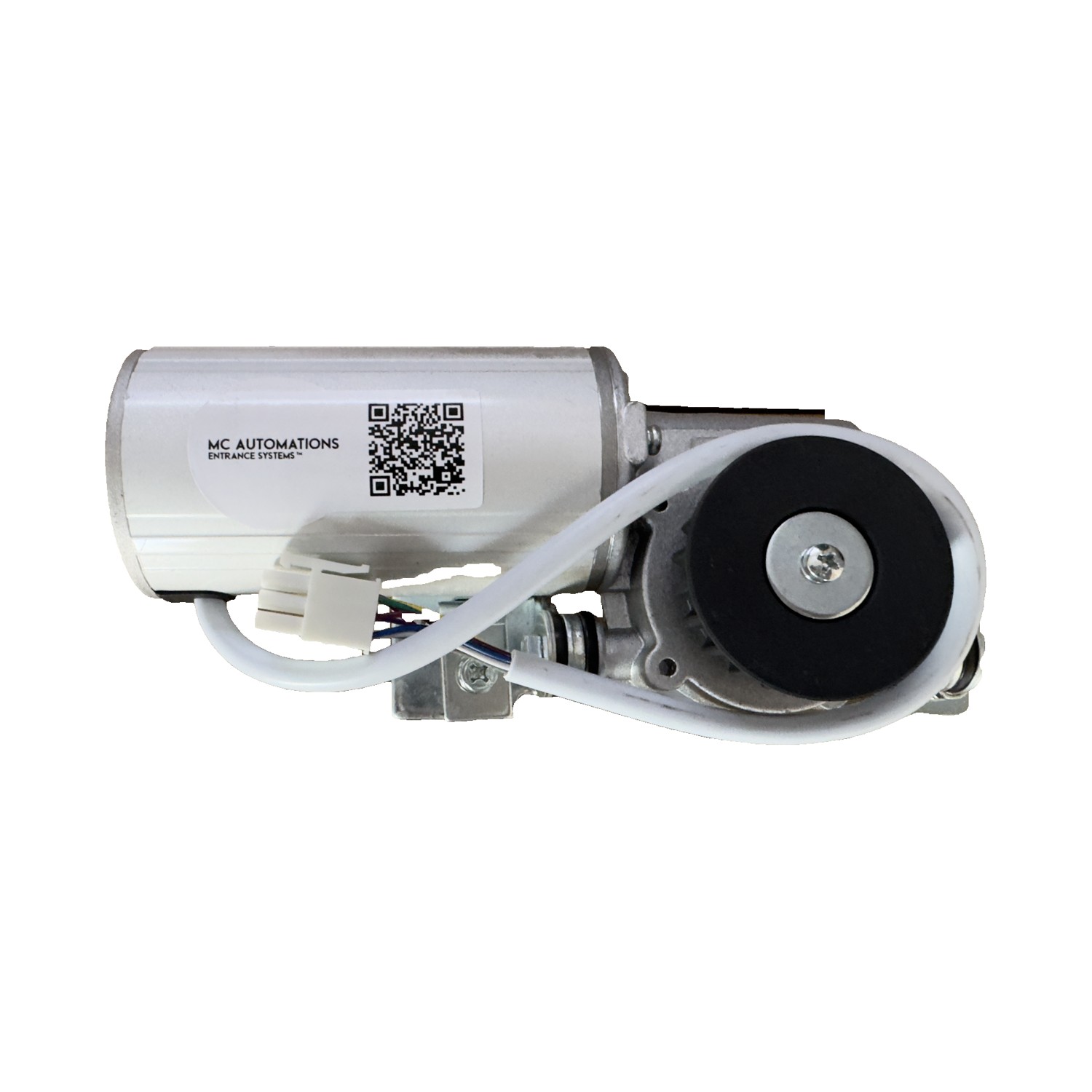
- Motor drive unit — the motor and gearbox that actually drives the belt. It usually outlasts everything else, but when it fails it’s a straight replacement on the existing frame.
- Belt brackets and end stops — the brackets clamp the panel to the belt; the end stops cushion the door at each end of its travel.
Sensors — safety and activation
- Activation (motion) sensor — detects someone approaching and tells the door to open. A faulty one leaves the door either dead or opening at random.
- Safety sensors — stop or reverse the door if someone is in the opening. When they’re dirty or failing, the door won’t close or keeps reversing. We stock the MC-507, Microcell One and MCW-100 safety sensors.
Control and access
- Control board (PC board) — the brain of the operator. Power surges and lightning are its biggest enemy in South Africa, so a surge-damaged board is a common replacement.
- Remote and receiver — for remote or keyed operation of the door’s modes.
- Electric lock (MC-125 Lock) — secures the door in the closed position after hours.
Floor guides
The nylon and frameless floor guides keep the bottom of the panel tracking true. They’re small, cheap, and wear steadily as grit collects in the track — an easy part to overlook until the door starts catching.
Match the symptom to the part: when to replace automatic door parts
A quick diagnostic shortcut — the likely culprits, in the order we usually find them:
- Door won’t close all the way → dirty or failing safety sensor, debris in the track, worn rollers, or a slack drive belt.
- Door opens on its own → the activation sensor is picking up stray movement (a banner in a draught, an aircon vent, reflective flooring).
- Door won’t open at all → check power and the mode switch first, then the activation sensor and control board.
- Noisy or juddery running → worn main rollers, a return-pulley bearing, or a loose belt.
- Door won’t lock → the electric lock.
Not sure which it is? Our guide to how automatic sliding doors work and common faults walks through the diagnostics in more detail.
What you can do yourself — and what needs a technician
Safe to DIY: wiping the sensor lenses clean, clearing grit and packaging out of the bottom track, and checking the mode switch hasn’t been left on “manual” or “locked”. These fix a surprising number of “faults” in seconds.

Call a technician for everything else. Belts, rollers, the motor and the control board mean live electrics and heavy glass panels — not a DIY job. If you’re past the clean-and-clear stage, book an automatic door repair.
Genuine MC-125 spares, delivered across South Africa
We supply genuine spare parts for the MC-125 automatic sliding door system — factory-direct and delivered nationwide. Order the exact part you need:
-

M-238 Door Switch
R3 669,90 (excl. VAT) Add to cart -

MC-125 Automatic Sliding Door Motor Drive Unit
R5 190,95 (excl. VAT) Add to cart -

MC-125 Automatic Sliding Door PC Board (Control Board)
R4 975,90 (excl. VAT) Add to cart -

MC-125 Belt Bracket Set
R688,21 (excl. VAT) Add to cart -

MC-125 Drive Belt (10 Metre)
R1 984,90 (excl. VAT) Add to cart -

MC-125 End Stops (Set of 2)
R345,90 (excl. VAT) Add to cart -

MC-125 Frameless Floor Guide
R195,00 (excl. VAT) Add to cart -

MC-125 Lock
R897,90 (excl. VAT) Add to cart
Browse the full range on our automatic door spare parts page. Not sure which part you need? Send us your operator model and a photo and we’ll point you to the right one.

How often should automatic doors be serviced?
We recommend preventative servicing every six months for a standard commercial entrance, and quarterly for high-traffic doors like centre entrances, hospitals and fast-food outlets. A scheduled service catches a worn roller or a fraying belt while it’s still a small, planned part swap — not an after-hours breakdown.
When To Replace Automatic Door Parts
Coetz Glazing designs, supplies and installs to spec, then services what we fit — contact us for a site measure and a fixed-price quote.

Frequently asked questions
How long does an automatic door drive belt last?
It depends entirely on cycle count, but on a busy retail entrance a drive belt is very much a wear item. A six-monthly service checks belt tension and condition so it’s replaced on your schedule rather than failing mid-trade.
Can I replace automatic door parts myself?

Cleaning sensors and clearing the track are safe DIY jobs. Anything involving the belt, rollers, motor or control board involves live electrics and heavy glass, so it should be done by a technician.
Do you supply spares for doors other than the MC-125?
Our online range covers the MC-125 system. If you run a different operator, get in touch with the make and model — we’ll tell you what we can source.
Do you deliver spares nationwide?
Yes — we deliver automatic door spares across South Africa. Order online, or contact us for help identifying the right part.
Need a part or a service?
Whether you need a single spare or a full service, we can help. Browse automatic door spare parts, book an automatic door repair, or get in touch for a quote.

When to replace automatic door parts: a practical checklist
Clients ask us, When to replace automatic door parts? The honest answer depends on the opening, the traffic through it and what the building already has in place, so the checklist below is what our estimators actually work through.
- The structural opening. Measure the brickwork opening rather than an existing frame, and note whether the reveal is square.
- Traffic and duty cycle. A quiet office entrance and a centre entrance passing thousands of people a day are not the same specification.
- Power and controls. Confirm what supply reaches the head of the opening, and whether access control, an intercom or a fire panel must interface.
- Glass. Coetz™ glazes as standard with 6.38 mm clear laminated safety glass.
- Service access. Automatic door systems are installed and serviced by our team, so plan for periodic servicing from day one.
If that question applies to one specific opening on your project, send us the sizes and a photo of the existing entrance. That is normally enough for us to answer it, and to quote, without a site visit.
When to replace automatic door parts on a high-traffic entrance
Duty cycle changes the answer more than age does. A quiet office side entrance might open two hundred times a day; a shopping-centre entrance can pass several thousand. Because wear is driven by cycles rather than calendar months, deciding when to replace automatic door parts should start with a realistic estimate of daily traffic rather than the date of the last service.
Symptoms that change the timing
Certain symptoms move a component from “monitor at the next service” to “replace now”. A belt that has begun to slip under load, a roller that has flat-spotted, a hanger with visible play, or a floor guide that has worn oval will all accelerate wear on everything connected to them. That is the practical rule for when to replace automatic door parts: a worn component rarely fails alone, because the load it stops carrying is transferred to the next part in the drive train.
Replace as a set, or individually?
Rollers and hangers are usually worth replacing as a set, because a new roller running alongside three worn ones simply carries more than its share. Belts, sensors and controllers are generally replaced individually once diagnosed. Where an entrance is already booked for attendance, grouping the work is normally cheaper than a second call-out a month later, which is worth weighing up when you plan when to replace automatic door parts across a portfolio of sites.
When to replace automatic door parts: common questions
When to replace automatic door parts: is there a service interval?
There is no single interval. Deciding when to replace automatic door parts depends on cycle count, environment and how the entrance is used, which is why a high-traffic retail door and a quiet office door on the same operator wear at very different rates.
Can I wait until a part actually fails?
You can, but it usually costs more. Running a worn component to destruction transfers load onto the parts around it, so the question of when to replace automatic door parts is really a question of whether you replace one item now or several later.
Do you supply parts without attendance?
Yes. Coetz™ stocks automatic door spares, so if your own technician has already diagnosed the fault and knows when to replace automatic door parts on that system, the components can be supplied directly.
Leave a Reply