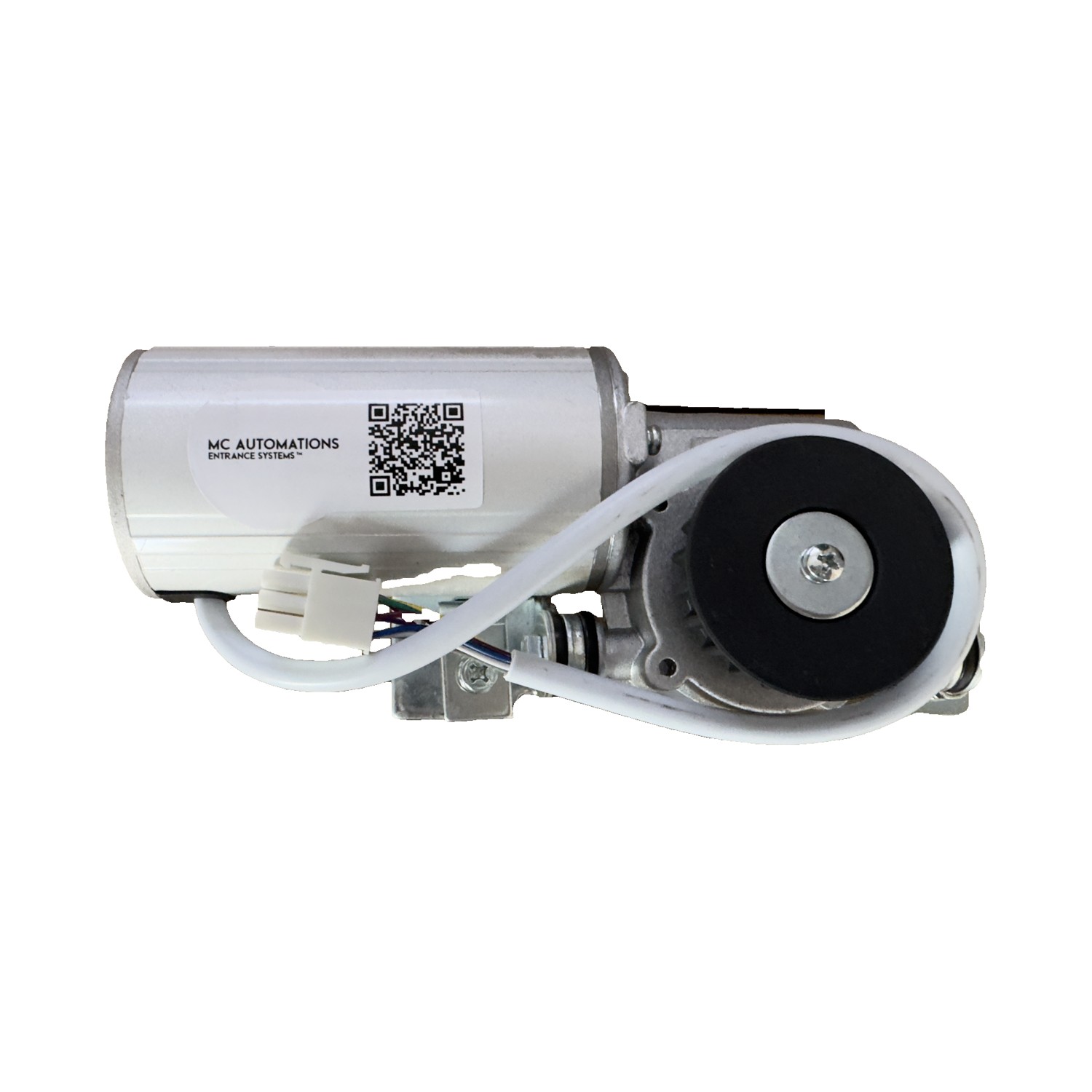
The sliding door motor is the heart of every automatic sliding entrance — the drive unit that quietly slides the door open and closed thousands of times a day. Whether you are building a new entrance or replacing a worn unit, the drive unit most trusted across South Africa is the MC-125 motor. This 2026 guide explains what a sliding door motor does, how the MC-125 works, what it costs, and how to replace one.

What is a sliding door motor?
A sliding door motor is the powered drive unit that moves an automatic sliding door along its track. It houses the motor, drive belt and controller, and it responds to sensors, remotes or access control to open the door on approach and close it safely behind you. In short, it is the part that turns a plain glass slider into a smooth, hands-free entrance.
The MC-125 sliding door motor
The MC-125 automatic sliding door motor drive unit is a heavy-duty operator built for high-traffic commercial entrances. It drives single-sliding and bi-parting doors, supports motion-sensor and touchless activation, and includes battery backup so the door keeps working through load shedding. Because it is a universal unit, the MC-125 can be configured to work with all major door brands and suits most existing sliding tracks.
How the drive unit works
Every sliding door motor follows the same basic cycle:
- Detect — a motion sensor or access control signals the drive unit.
- Drive — the motor turns a toothed belt that pulls the door panel along its track.
- Hold — the door stays open for an adjustable dwell time.
- Close — the unit closes the door gently, reversing if a safety sensor detects a person.
Everything is tuned by the controller, so opening speed, hold time and force all adjust to the building.
Sliding door motor price in South Africa
The MC-125 sliding door motor is priced from R5,190.95 (excl. VAT) as a replacement drive unit. A complete new operator with sensors, remotes and battery backup is quoted separately. Because Coetz™ supplies nationwide, you get factory-direct pricing on your motor and spares wherever you are in the country, with installation available in Gauteng.
Is the sliding door motor actually the fault?
This is the question worth answering before any money is spent, because a door that will not move is not the same thing as a failed drive unit. Several cheaper components produce symptoms that look exactly like motor failure, and replacing a healthy sliding door motor fixes nothing.
A sensible diagnosis works from the outside in, cheapest and most likely first:
- Power. Confirm the operator actually has supply at the header. Tripped circuits and isolators switched off during other work are more common than any mechanical fault.
- Activation. If the door does not respond to approach but does respond to a manual push-button or remote, the fault is in the activation sensor, not the drive.
- Safety and presence detection. A door that opens but refuses to close is usually receiving a continuous presence signal. That is a sensor aim or contamination problem.
- Mechanical resistance. Worn rollers, a dropped leaf or debris in the track make the door heavy. The motor then draws more current and can appear to be failing when it is simply overloaded.
- Drive belt. A slipping, stretched or damaged belt produces jerking, incomplete opening and loss of drive — the symptoms most often mistaken for a dead sliding door motor.
- Controller. The board governs speed, acceleration, deceleration and timing, so a controller fault can mimic almost any mechanical symptom.
Only once those are eliminated is the motor itself the likely culprit. That order matters commercially: the belt, rollers and sensors are inexpensive and held in stock, while the drive unit is the single most expensive component in the header.

What shortens the life of a sliding door motor
A commercial drive unit is designed to cycle continuously for years. When one fails early, the cause is almost always the conditions it was asked to work in rather than the unit itself.
- Grit in the track. Dust and building sand act as a grinding paste under the rollers. The rollers stiffen, the door gets heavy, and the sliding door motor works harder on every single cycle.
- Short-cycling. A badly aimed sensor that triggers on passing foot or vehicle traffic can double or triple the real cycle count. Every unnecessary cycle is deducted from the life of the mechanism.
- Running a binding door. A leaf that has dropped or gone out of alignment is often simply pushed harder. The motor compensates, draws more current, and wear accelerates sharply.
- Ignoring early symptoms. A new noise, a hesitation, or a door that no longer closes fully are cheap to correct at that point and expensive once they have damaged something else.
- Deferred servicing. Belt tension, roller condition and sensor alignment all drift gradually. None of them announce themselves until something stops.
None of these are exotic. Keeping the track clean and having the sensors and belt checked periodically is the difference between a drive unit that lasts and one that does not.
Replacing a sliding door motor
When an automatic door slows, sticks or stops, the drive unit is often the cause. Replacing a sliding door motor is usually straightforward: the old unit is unbolted from the header, the new MC-125 is fitted to the existing track, and the controller and sensors are re-connected and tuned. Most swaps are completed in a few hours, restoring smooth operation without replacing the whole door.
Repair or replace: how to decide
Not every faulty operator is worth repairing, and not every working one is worth keeping. The decision usually comes down to parts availability and how much of the header has already been replaced.
- Repair generally makes sense where the operator is a current model, the fault is confined to a stocked wear part such as a belt, roller set, sensor or control board, and the mechanical condition of the track and leaves is sound.
- Replacement generally makes sense where the unit is obsolete and parts are no longer available, where repeated faults have appeared across different components, or where the cost of the next repair approaches the cost of a new drive unit.
Replacing the sliding door motor rarely means replacing the entrance. Where the existing track, leaves, aluminium framing and structural opening are in good order, a universal drive unit such as the MC-125 can usually be fitted to what is already there. That is the practical advantage of a universal operator: the expensive glass and framing stay, and only the working parts change.
What to check before ordering a replacement drive unit
Sending the following with an enquiry means a replacement sliding door motor can be confirmed without a second round of questions, and avoids the far more expensive mistake of ordering the wrong unit.
- Single-sliding or bi-parting. Whether one leaf slides to one side, or two leaves part in the middle.
- Clear opening width and height in millimetres, measured to the structure rather than to an existing frame.
- Leaf weight, or the glass specification and frame it is made from, since leaf weight is what the operator must be matched to.
- The existing track and header arrangement, ideally photographed with the header cover removed.
- What is currently fitted — make and model if legible, and which components have already been replaced.
- Activation and access control in use — motion sensors, push buttons, remotes, card readers, intercoms or electric locking.
- Whether battery backup is required, which for most South African sites it is.
A photograph of the open header is worth more than any written description. It shows the track profile, the belt run and the mounting arrangement in one image, which is normally enough to confirm compatibility. If the header cover cannot be safely removed, send what you can see from below along with the opening dimensions and we will tell you what else is needed. It is always worth confirming before ordering rather than discovering a mismatch once the old unit is already off the wall and the entrance is out of service.
Specs, servicing and maintenance
A commercial drive unit is built to cycle continuously, so a few basics keep it reliable: keep the track clean of grit, check the drive belt tension periodically, and replace consumable rollers and batteries on schedule. Coetz™ stocks the matching automatic door spares — rollers, belts, sensors and remotes — so a serviceable unit stays serviceable for years. Pair the motor with the right sensors from our automatic door sensor price guide.

Where sliding door motors are used
Sliding door motors suit any high-traffic entrance that needs hands-free access:
- Retail and malls — wide, welcoming automatic entrances.
- Offices and receptions — a premium, frameless glass entrance.
- Hospitals and clinics — touch-free, hygienic movement.
- Hotels and showrooms — smooth, quiet operation all day.
For hinged doors, an operator suits better — see our automatic door opener guide, or compare complete automated door systems.
Access control, integration and efficiency
Beyond opening on approach, a modern drive unit integrates with the systems a building already runs. Wire it to keypads, card readers or intercoms to manage who enters and when; link it to the fire alarm so the entrance fails safe in an emergency; or add timers that secure the premises after hours. Push-button and wave switches give staff a simple manual override, while remote fobs suit smaller sites.
Efficiency matters too: low-energy operators draw little power, and an adjustable hold-open time means the entrance is not left standing open, which helps keep heated or cooled air inside. Reliable presence detection reduces unnecessary cycles, extending the life of the mechanism and trimming running costs.
Because one universal operator can be tuned to a shop, an office or a clinic, you specify a single, familiar sliding door motor across a whole portfolio of buildings — simplifying training, spares and support for facilities teams.
Why choose Coetz™ for your sliding door motor
Coetz™ Glazing, with MC Automations Entrance Systems, supplies and installs sliding door motors and complete systems across South Africa. Explore the full range of automatic door systems or read our door automation guide, then contact our team for a quote. Quality drive units follow safety standards such as EN 16005 for power-operated pedestrian doors.
Commissioning: the settings that protect the drive unit
Fitting the operator is the shorter half of the job. Commissioning is where the settings are matched to the building, and those settings have a direct bearing on how long the mechanism lasts.
- Deceleration. A door that slows before reaching its end stops puts far lower peak loads through the rollers, belt and drive on every cycle than one arriving at full speed.
- Hold-open time. Set too short and the door closes on people, then reopens — two cycles where one was needed. Set sensibly, it cuts unnecessary cycles.
- Sensor aim. Activation detection should cover the real approach path and nothing else. A sensor picking up passing traffic is the most common cause of short-cycling.
- Opening and closing speed. Fast enough to keep pedestrians moving, slow enough that the entrance is not slamming through its travel all day.
- Access-control sequencing. The lock release and the operator must be sequenced correctly, or the door fights its own locking on every use.
Ask for a brief handover at the end. Whoever manages the building should know how to change operating mode, how to release the leaves by hand during a power failure, and what the entrance sounds like when it is running properly. That last point matters more than it sounds: a new noise is the earliest and cheapest warning a sliding door motor gives before something more expensive happens.

Sliding door motor FAQ
Can I replace just the sliding door motor?
Usually yes. The MC-125 is a universal drive unit that fits most existing tracks and configures to all major door brands, so the glass leaves, aluminium framing and structural opening normally stay exactly as they are.
How much is a sliding door motor in South Africa?
The MC-125 sliding door motor drive unit is priced from R5,190.95 (excl. VAT), supplied nationwide. A complete new operator with sensors, remotes and battery backup is quoted separately.
Does a sliding door motor work during load shedding?
Yes — the MC-125 includes battery backup, so the door keeps operating and fails safely on power loss. The leaves can also be moved by hand if needed, so nobody is trapped.
How do I know whether the motor has failed or something else has?
Work from the outside in. Check power at the header, then activation, then safety sensors, then mechanical resistance in the track, then the drive belt, then the controller. Several of those produce symptoms identical to motor failure and all of them are cheaper to fix, so the drive unit should be the last conclusion rather than the first.
How long should a sliding door motor last?
A commercial drive unit is built to cycle continuously for years. Actual life depends far more on conditions than on the unit — grit in the track, short-cycling from badly aimed sensors, and running a binding door are what shorten it.
What information do you need to quote a replacement drive unit?
Whether the door is single-sliding or bi-parting, the clear opening width and height in millimetres, the leaf weight or glass specification, a photograph of the existing header with the cover off, what is currently fitted, and which activation or access-control equipment is in use.
Can a sliding door motor work with access control?
Yes. The drive unit integrates with keypads, card readers, biometric readers, intercoms and electric locking, and can be linked to the fire alarm so the entrance fails safe. Integrating at commissioning rather than retrofitting later avoids short-cycling, which otherwise consumes the mechanism’s life faster than the traffic alone would.
Do you install, or supply only?
Automatic doors are the installed exception in the Coetz™ range. The sliding door motor is supplied nationwide, with installation and servicing arranged through MC Automations Entrance Systems, and spares held in Johannesburg so a repair is not waiting on an imported part.
Related automatic-door guides
- What is an automatic door operator?
- Choosing an automatic door operator
- What size automatic door operator do I need?
- Automatic sliding door durability: one million cycles explained

What affects the price of a sliding door motor
Two quotations for a sliding door motor can differ widely, and the reason is almost always a specification difference rather than a margin difference. These are the variables that move the number.
- The structural opening. Measure the brickwork opening rather than an existing frame, and note whether the reveal is square.
- Traffic and duty cycle. A quiet office entrance and a centre entrance passing thousands of people a day are not the same specification.
- Power and controls. Confirm what supply reaches the head of the opening, and whether access control, an intercom or a fire panel must interface.
- Glass. Coetz™ glazes as standard with 6.38 mm clear laminated safety glass.
- Service access. Automatic door systems are installed and serviced by our team, so plan for periodic servicing from day one.
Once those are pinned down, a sliding door motor becomes straightforward to quote and to programme. Send them through with your enquiry and we will come back with a firm price for the sliding door motor and any spares it needs.
Leave a Reply